
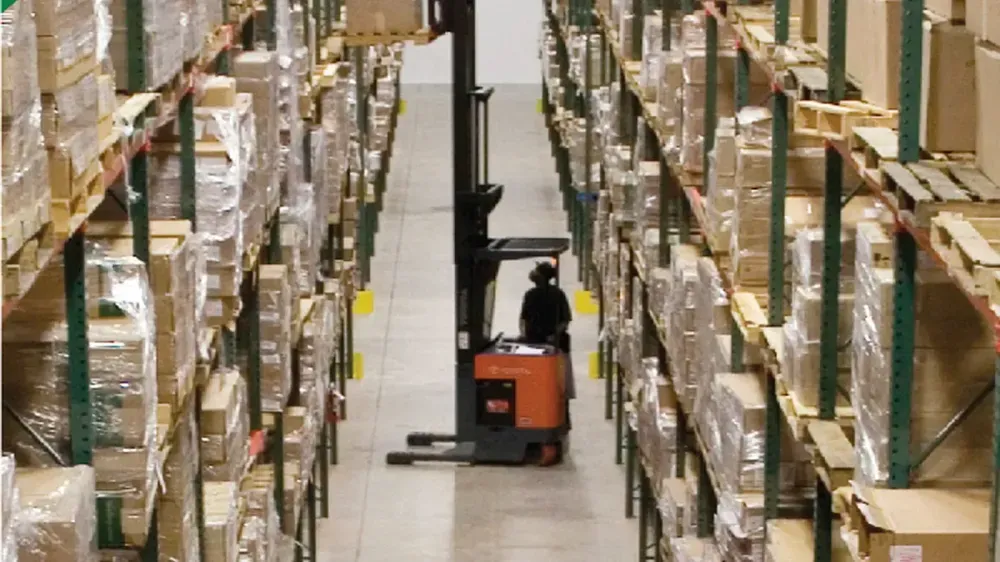
What Is a Smart Warehouse?
A clear look at what a smart warehouse is made of, how it differs from a conventional one, and which businesses benefit most from starting now.
Published
Every transaction is captured at the source, so stock updates the moment it is scanned.
Software, data-capture hardware, shared data and system integration.
Managers see the whole warehouse and pull the report they need without chasing files.
You do not have to rebuild the warehouse; begin with the most painful process.
What is a smart warehouse?
A smart warehouse keeps the system record and the physical stock in agreement at all times, because every receipt, issue, transfer and count is captured digitally where the work happens rather than keyed in later. That continuous flow of data is what lets the warehouse team, sales, purchasing and finance work from the same numbers instead of reconciling their own.
- Records match the physical stock without waiting for a full stocktake
- Staff follow a defined process instead of relying on memory
- Managers see current status immediately and can trace who did what and when
- Results are measurable, so the next improvement has a direction
Measurable differences from a conventional warehouse
Many warehouses still run on paper documents or a spreadsheet per department, so the balance is a picture taken after the work rather than during it. When goods leave the shelf before anyone records them, the system still claims the stock is there, and an order that should have been fulfilled on paper gets delayed in practice.
- Recording: keyed in later versus captured at the point of work
- Accuracy: fewer reading and entry mistakes once scanning is in place
- Finding stock: an instant storage location instead of a walk from memory
- Reporting: an immediate report instead of assembling files at month end
The four layers that make up a smart warehouse
A smart warehouse is not one piece of technology but four layers working together. When any single layer is weak the others cannot deliver, which is why a good scanner does not fix a process whose data ends up in the wrong place.
Software, hardware, data and integration
Good planning starts from the decisions the business needs to make, then picks the tools that feed those decisions, rather than starting from whichever tool is cheapest.
- Warehouse management software (WMS) sets the rules, locations and stock policy
- Data-capture hardware such as scanners, label printers and handheld devices
- Shared data: the live balance, the movement history and the true cost
- Integration with systems such as accounting or ERP so nothing is entered twice
The path from a scan on the floor to a management report
The strongest part of a smart warehouse is that data is created once and then flows to every place that needs it. A single scan deducts stock, updates the accounting view and refreshes the dashboard at the same time, so there is no re-keying step and no gap where mistakes creep in.
When everyone works from one data set, cross-team meetings start from agreed facts instead of a debate about whose number is right.
- Goods-in scan: records quantity, cost and expiry according to the rules you set
- Issue scan: deducts stock under the product policy and warns when reorder level is reached
- Audit trail: shows who made which movement, when, and from which device
- Automatic reports: sales, best sellers and aged stock ready without manual collation
Signals that your warehouse is ready for the next step
You do not need a large warehouse or a complex system before you begin. The signals are repeated errors that headcount alone can no longer absorb, or growth that the current way of working cannot carry, such as new branches, a new online channel, or a catalogue that keeps expanding every quarter.
- Records and physical stock disagree, and finding the cause takes longer each time
- Staff spend most of their day searching for goods rather than adding value
- Stockouts and aged stock happen in the same business at the same time
- Departments quote different figures and every meeting re-confirms balances
- You are adding branches, channels or a second warehouse and need one shared rule set
How to start without rebuilding the whole warehouse
The approach that works is to start with the single process that causes the most pain, prove the result there, and then extend it to the neighbouring steps. Once the team sees that accurate data removes rework, widening the scope becomes easier because staff become advocates rather than bystanders.
A dependable order: choose the first process, standardise item codes and storage locations, train the team on a limited scope, measure against the old way, then extend in stages.
- Set the measures in advance, such as counting time or corrections per period
- Standardise item codes and storage locations first, since everything else depends on them
- Start with a small, controllable group of items so the team can build confidence
- Extend to the next zone or branch once the measures improve consistently
Let our engineers pick the right hardware and labels for your site
Send us a sample or describe your site and the iStock Express team will run the tests and report back before you invest.