
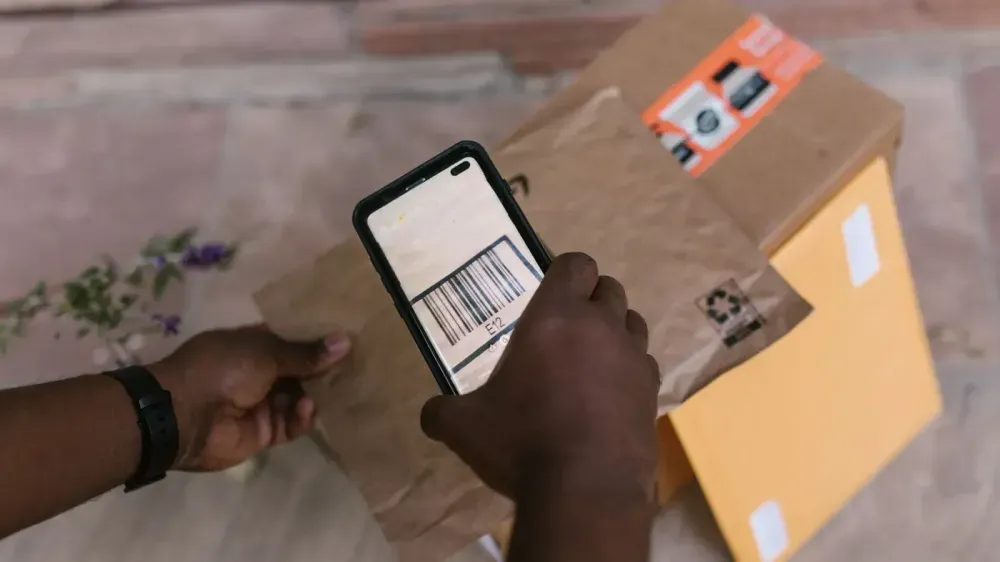
How to Choose Labels That Stay Put in the Warehouse
An engineering guide to choosing facestock, adhesive and ribbon for the real environment, so labels stop peeling, barcodes keep scanning, and shipping errors stop cutting into margin.
Published
Read the surface energy (LSE vs HSE) of cartons, plastic bins and wood.
From -40°C freezer rooms to outdoor areas that bake in direct sun.
Permanent, removable, freezer grade, or high-tack for rough surfaces.
Dwell-time checks and ISO 15415 verifier grading before you commit.
Match the facestock to the warehouse environment
The facestock takes the print and the scratches. Choosing the right face material keeps barcodes sharp and scan errors below 0.2% for the life of the label.
Pick a material that survives real handling
From plain corrugated boxes to frozen pallets, temperature and humidity drive how ink and adhesive behave. Pairing the face material with the right ribbon prevents smearing and tearing.
- Semi-Gloss: the cost-effective default for corrugated boxes in dry storage
- Synthetic PP Matte / PE Film: no fibre tear, handles moisture and cold vapour at -40°C
- Polyester (PET): rated above 150°C and resistant to oils and production chemicals
- Removable Film: lifts clean off tote bins and rotating pallets with no residue
Adhesive is what stops label edges from lifting
Good paper still fails when the adhesive does not match the surface energy of the container. Edge lifting starts within hours, so the adhesive must be chosen for the substrate.
Four adhesive families by surface type
Assessing recycled corrugated board, smooth plastic drums or rough wooden pallets lets the engineer specify the right adhesive thickness and chemistry.
- Permanent: bonds harder over time and cannot be peeled without tearing
- Removable: holds in transit and lifts cleanly with no sticky residue
- Freezer grade: stays flexible at -40°C and sticks through surface frost
- High-Tack: extra-thick adhesive that grips rough or dusty surfaces
Engineering tests that run before production
To avoid downtime on the line or failed label scanning in the warehouse, every batch passes four quality checks before it ships.
Four-step quality protocol
The protocol is what guarantees a batch behaves on your floor instead of requiring a reprint.
- Printability test: barcode sharpness at the real print speed of 6-10 ips
- Adhesion & dwell time: pull test on the real surface after 24-48 hours
- Extreme simulation: freeze, heat and alcohol rub tests
- Barcode verifier grade: ISO/IEC 15415 grade A or B, nothing lower
Summary of the label selection rules
A quick reference for the technical requirements and printer pairing that keep warehouse labelling efficient.
Ribbon and printhead pairing
Supported printers: Zebra, Honeywell, TSC, Citizen, Sato (Direct Thermal & TTR) Recommended resolution: 203 dpi for standard 1D barcodes / 300 dpi for small Data Matrix and QR codes Ribbon pairing: Wax for Semi-Gloss paper / Wax-Resin for synthetics / Full Resin for chemical films
Send us a carton or product and we test its adhesive and ribbon for free
Our engineers run peel-adhesion tests on your sample and issue a barcode verifier report before you place the production order.
Related articles

Inside RFID for Automated Stock Counting
Scan hundreds of items in seconds and cut counting time in large warehouses by up to 80%.

Barcode vs RFID: What Is the Difference?
Compare product-tracking technologies to choose the right approach for your business.
Introducing Real-time Multi-Warehouse Sync
Connect multiple warehouses and leading e-commerce channels with real-time stock deduction that stops overselling and stockouts.